
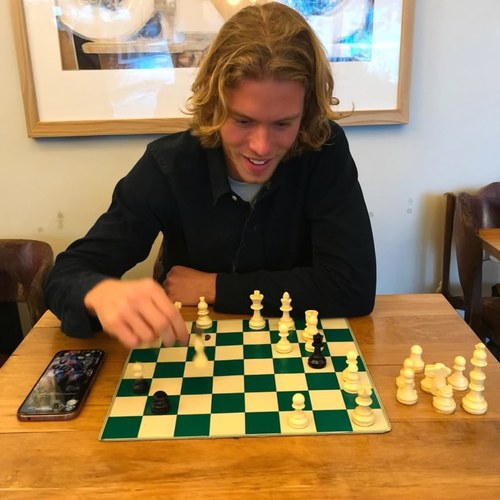
Checkers looks simple, and the rules really are, but the gap between a casual player and a strong one is huge. Once I learned a handful of strategic ideas I went from losing most games to winning the vast majority of casual ones. No single trick makes you unbeatable, yet these principles stack up fast. Here is the Checkers strategy that has done the most for my results, all of which you can practice against the computer in the browser.
Control the center early
The squares in the middle of the board give your pieces the most diagonal options, while pieces stuck on the edges can only move one way. I try to push toward the center in the opening, building a solid block of pieces that supports each other. A central piece threatens more squares and is harder to trap, so winning the middle quietly wins a lot of games before any captures happen.
Use the forced capture rule
In most rules a player must take a jump if one is available. That sounds like a downside for whoever has to jump, but a smart player turns it into a weapon. By offering a piece in just the right spot, you can force your opponent to jump exactly where you want, then capture two or more of their pieces on your reply. Setting up these forced trades is the heart of advanced Checkers.
Trade when you are ahead
If you have more pieces than your opponent, trading pieces one for one helps you. Each swap brings the board closer to a clean material advantage you can convert. When I am up a piece, I look to simplify. When I am behind, I avoid trades and keep the board complicated so I have chances to claw back.
Protect your back row
Your back row is the line your opponent must reach to crown a king, so holding it slows their promotions. I keep my back rank intact in the early and middle game where I can. The catch is that those pieces are not doing much else, so late in the game I let the back row break to free those pieces for the fight. It is a balance between defense and activity.
Race to make a king
A king moves and captures both forward and backward, which roughly doubles its usefulness. Getting the first king is often the moment a game tips in your favor. I keep an eye on any clear lane to the back row and push a piece up it when my opponent cannot block in time. Just be careful not to send a lone piece into a trap on the way.
Common traps and how to use them
A few setups come up again and again, and knowing them helps on both attack and defense:
- The double jump bait. Leave a piece where capturing it forces your opponent into a position you can punish with a multi jump.
- The edge pin. Drive an opponent piece to the side where it has only one move, then take it on your terms.
- The trade up. Offer a one for one swap that opens a lane for your own promotion.
Watch for these being set against you too. If a free capture looks too good, pause and check what your opponent gets back.
Think one move ahead, then two
Before any move I ask what my opponent can do in reply, especially what they can capture. Most of my early losses came from happily taking a piece without seeing the jump waiting for me afterward. Slowing down to picture the next exchange is the simplest upgrade you can make to your game.
Put the strategy to work
Reading about strategy only goes so far, so the real learning happens at the board. Try controlling the center, setting up a forced trade, and racing for that first king. You can play Checkers free here against the computer and test these ideas right away. If you like thinking several moves deep, you will probably enjoy Chess and the quick tactical battle of Connect Four as well.
FAQ
What is the strongest general checkers strategy?
Phalanx play: advance connected, mutually guarded pieces toward the center, keep your back row intact early, and force trades only when ahead. Structure beats speed at every level below master.
How do I set traps in checkers?
Exploit forced captures: offer a piece whose compulsory jump pulls your opponent onto a square you double-jump back from. Counting the full exchange before offering is what separates a trap from a gift.
When should I aim for a king?
After the midgame trades clarify lanes, early king-runs strand pieces. A protected king arriving on schedule is worth two pawns of positional advantage; an early solo runner usually dies for nothing.